We let our spouse know when a preparation is short on salt. But how often do we express how perfectly salted a dish is? Hmm…
If you're anything like me, you've noticed that we tend to speak up when something is missing or gone awry, and take for granted when life is quietly going right. Psychologist Rick Hanson puts it memorably, "the brain is like Velcro for negative experiences, but Teflon for positive ones."
So what pulls us out of that groove? I have often heard my dear spiritual master, Śrīla Romapāda Swāmī say, "Gratitude is the bridge to transcendence." The longer I sit with these words, the more I see them as a practical map, not just a loving sentiment.
The Transition Point
Śrīla Bhakti Vijñāna Goswāmī offers a beautiful image. Imagine a spectrum of emotions. At one end sit shame, anger, grief, fear, and attachment, which create an ethos in our mind and body that we often do not enjoy. At the other end are the spiritual emotions Rūpa Goswāmī describes in Bhakti-rasāmṛta-sindhu. And right in the middle?
"The most elevated sāttvik emotion is the emotion of gratitude… That's the sāttvik transitional point from the realm of material emotions to spiritual emotions… And the beauty of this is that we can work on it."
We can work on it! I find that so hopeful. We may not be able to manufacture spiritual emotions, but we can cultivate gratitude, and gratitude has the potential to bridge us across!
And we are in good company: In the Rāmāyaṇa, Lakṣmaṇa tells Hanumān about Śrī Rāma: "He is grateful and considers little acts of service to be great." Śrīla Prabhupāda echoed this: "If you give little service to Kṛṣṇa sincerely, Kṛṣṇa will never forget you."
Prabhupāda didn't just speak about gratitude, he lived it. Viśākhā devī dāsī remembers sitting on a dark landing in Bombay, quietly chanting japa while waiting to join his morning walk. As he passed, he said in his baritone voice, with complete gravity, "Thank you very much." All she was doing was chanting!
Practice, Not Attitude
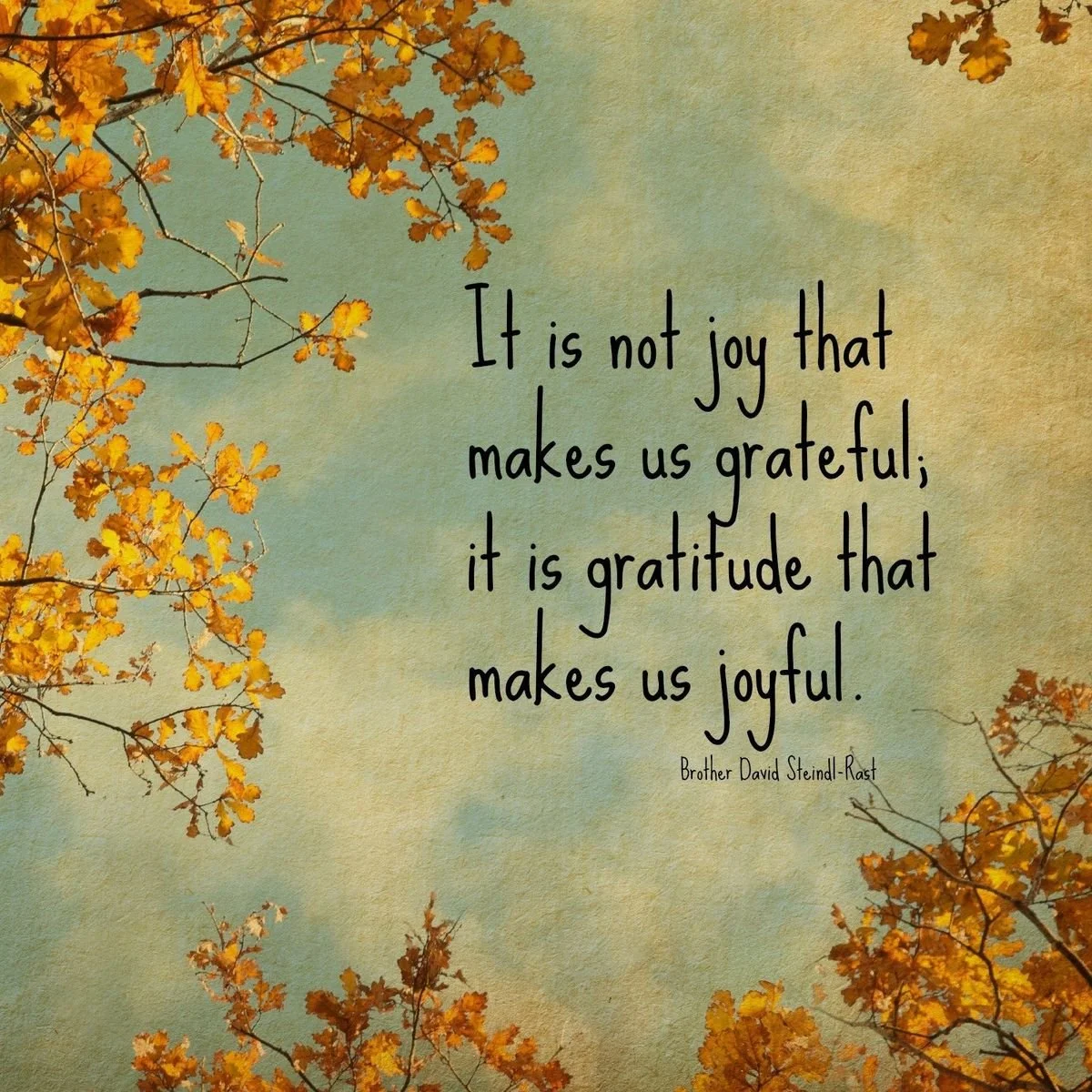
Benedictine monk David Steindl-Rast says, "It is not joy that makes us grateful; it is gratitude that makes us joyful." Researcher Brené Brown's twelve years of research back this up. She did not interview a single person who described themselves as joyful who did not actively practice gratitude.
Notice the word practice. Gratitude is not a vague attitude we wait to feel. It's a daily, intentional action. Shawn Achor found that after 21 days of writing down three things you are grateful for, the brain starts "scanning the world not for the negative, but for the positive first."
So I put this to test in my own home. I created a gratitude corner with the slogan, "It is not joy that makes us grateful, but gratitude that makes us joyful." Each family member has a jar with their name on it, and there's a stack of index cards and pens handy. Every night, I write a card for each person.
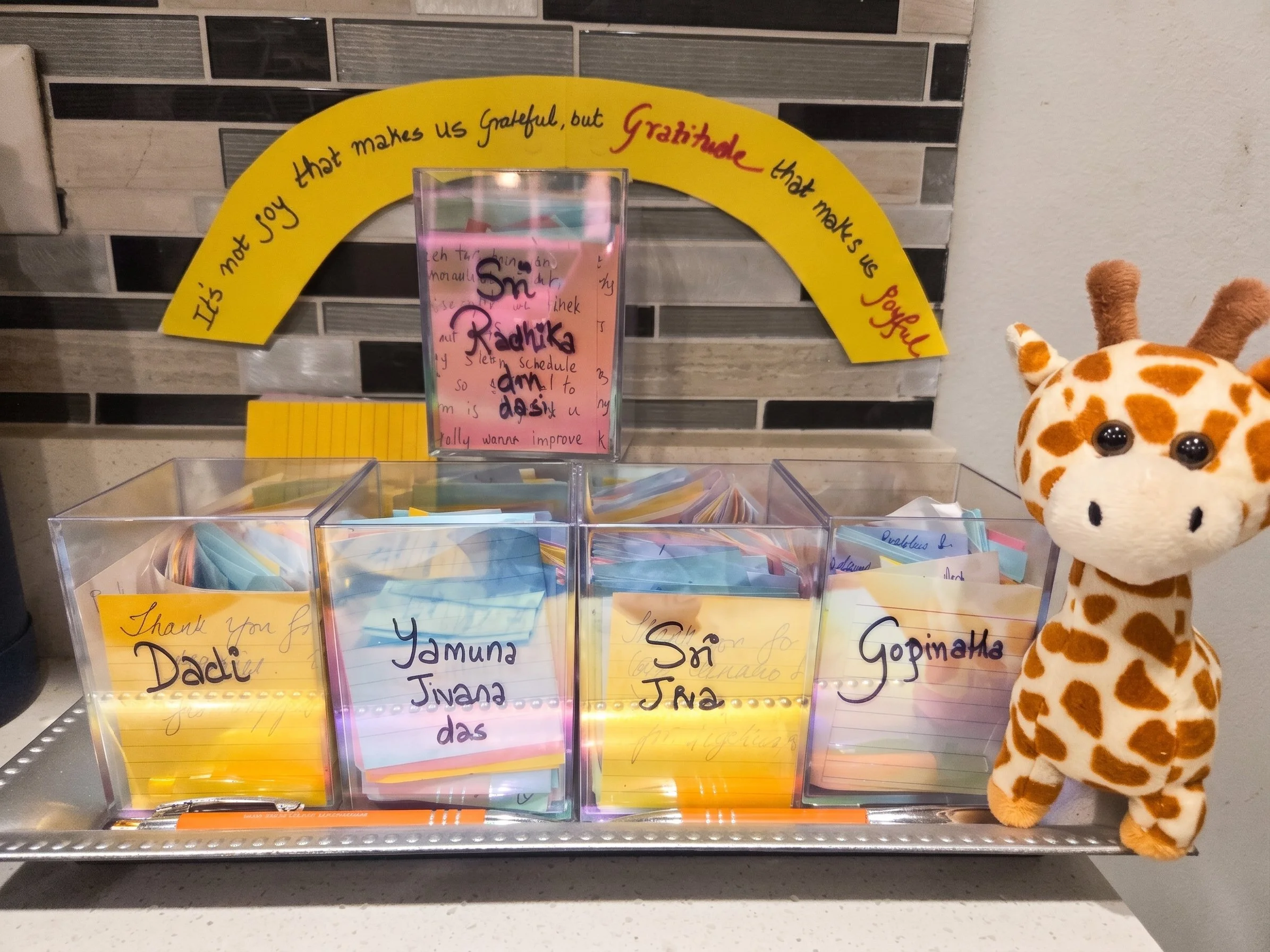
Has my negativity bias completely dissolved? Heck no! But I've noticed something shifting: during the day, my brain goes looking for moments to write about. When someone says or does something that meets my needs, I make a mental note for my cards that night. I'm finding so much more joy. And my sons have started writing notes too, including the one who finds it hard to express emotions out loud.
Gratitude, the NVC Way
Over many years of trying different gratitude practices, none has come close to the meaning I find in the Nonviolent Communication (NVC) process of expressing gratitude. One caution first: we keep the intention of connection front and center. Gratitude is not a tool to manipulate behavior or get into someone's "good books."
We use the same four steps of the NVC model:
Observation. Name specifically what the person did or said. This gives them concrete feedback, rather than a vague "good girl" or "good boy." "Dear son, when we were discussing where our guests would stay, you said you'd be happy to sleep in the basement or on the floor of our room."
Feeling. Share what stirred in you. "I felt delighted and joyful."
Need. Name the needs that were met; this grounds your appreciation. "It met my needs for togetherness in solving the dilemma of how to host guests. I so much yearn to contribute to the lives of people who come from out of town to attend retreats at our temple. It also gives me reassurance that you know when to prioritize connection over comfort, and this is the kind of human I want to raise!"
Request (optional). This can be a connection request, "How is this for you to hear?", or an action request, "Will you be willing to let me know, if, at any time, moving out of your room to accommodate guests doesn't meet your needs for privacy and ease?"
Can you feel the difference between that and a quick "Thanks, you're the best"? One says I see you. The other just passes by.
Get Drunk on Gratitude
A saying often attributed to Rumi is, "Gratitude is the wine of the soul. Go on. Get drunk!" Just as wine alters one's vision, gratitude colors how we see the world. I am finding this to be true in my own life!
One of the best books I ever read is the personal diary of Etty Hillesum, a Jewish woman held at the Westerbork camp before she was killed in 1943. She was full of gratitude! Here’s one diary entry, “At night, too, when I lie in bed and rest in You, oh God, tears of gratitude run down my face, and that is my prayer." Compared to Etty's circumstances, most of us have it so easy! We have so much to be grateful for. We just need the inner orientation of the heart to see it.
So here's my invitation: tonight, pick one person who met a need of yours today. Write them a note with an observation, a feeling, and a need. Then watch what happens, in them and in you. Let's catch each other doing something right!