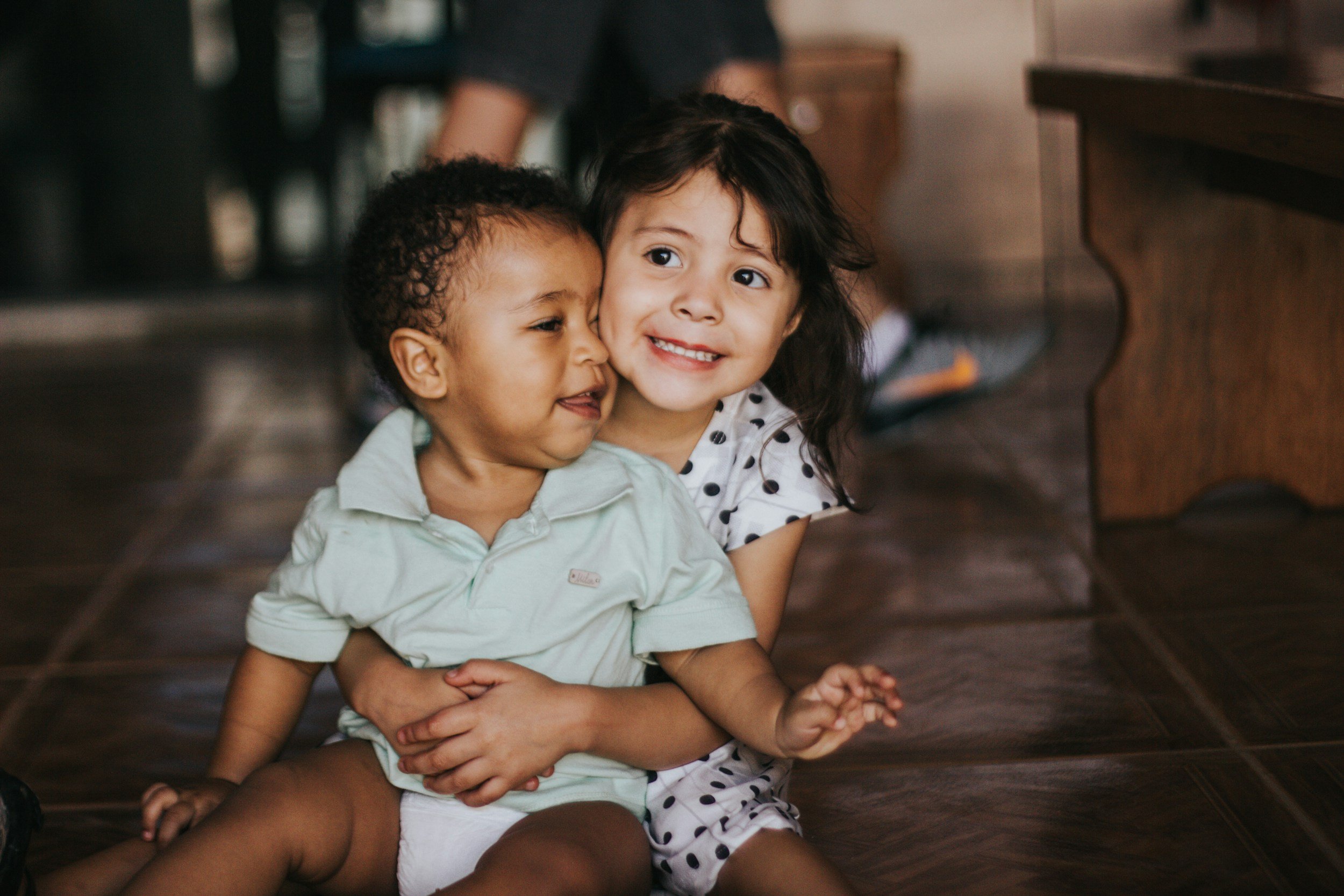
Your younger child cries out in pain. Their older sibling has just hit them. And before you can even take a breath, the words fly out of your mouth: “Say you’re sorry!”
We’ve all been there.
But let’s pause for a moment. Does a forced apology truly teach the older child to care about their sibling’s pain?
Compassion and empathy are often used interchangeably, but there is a helpful distinction between them. Compassion is an orientation of the heart—a deeply held value of caring for others. Empathy is the concrete set of skills that puts that compassion into action. And here is the good news: empathy is not an innate, unchangeable personality trait. It is a skill set we can model and practice every single day in our homes.
The Roots of Altruism: Punitive Discipline vs. Needs-Orientation
One of the best books I recently read is The Altruistic Personality: Rescuers of Jews in Nazi Europe. Its authors, Samuel and Pearl Oliner, studied people who risked their lives to rescue Jews during the Holocaust, comparing their backgrounds, values, and family relationships with those of people who simply stood by or explicitly declined requests for help. Their central message? Altruism is not just an inborn quality possessed by a few exceptional people: it is shaped by upbringing.
One of the book’s key findings was that rescuers were raised in families where discipline was non-punitive. Their parents’ discipline included “a heavy dose of reasoning—explanations of why behaviors are inappropriate, often with reference to their consequences for others.” These parents modeled generosity without concern for external rewards or reciprocity. Rather than demanding blind obedience, they guided their children toward shared moral values.
In stark contrast, bystanders and non-rescuers often had parents who were punitive, harsh, and focused on status. Discipline in those homes relied heavily on punishment and authority for its own sake. As a result, those children learned to keep their impulses in check by submitting to external power—a pattern linked to emotional constriction and a rejection of those perceived as weak.
The takeaway from this research is profound in its simplicity:
Children learn empathy by being empathized with.
“Power-With” vs “Power-Over”
So, if we want our older child to feel the younger one’s pain, we might first ask ourselves a more tender question: How often does my older child experience being empathized with?
For the past few years, I have been part of a parenting support group led by Aya Caspi, a Certified Trainer in Nonviolent Communication (NVC). When I sought support with challenges within my home related to sibling rivalry, she gently invited me to examine how often I was relating to my children from “power-over” rather than “power-with.” Then she named a hard truth: if I am using power-over my older son, he will naturally seek a sense of agency by using power-over his younger brother. The more I shift into a power-with relationship—partnering with him rather than coercing him—the less he would need to exercise his agency to dominate someone smaller than himself.
To shift this deeply ingrained paradigm is an ongoing journey for me. And, I am watching the cycle of harshness unravel before my very eyes. Daily, I am learning that we cultivate an empathic home by modeling empathy—navigating our human interactions with care for the impact our words and actions have on others.
Back to the younger sibling being in pain scenario, Marshall Rosenberg, who developed NVC, invited parents to ask two questions when determining how to administer discipline:
What do I want my child to do?
What do I want my child’s reasons to be for doing it?
A forced “sorry” may answer the first question. Only empathy can answer the second.
Cultivating a Home Oriented to Needs & Impacts
During this past summer, my teenager woke up at noon and we got into the car for a drive to the barber. When I asked him if he had brushed his teeth, he said that he was planning on doing so along with his post-haircut shower. Practicing orienting him to needs, rather than should’s and have-to’s, I said, “I want you to consider the impacts of your choices on me. I am scared that if your teeth are not brushed until mid-afternoon, I will need to take you more often to the dentist. Consider the impacts of this on my work schedule and finances.”
Here’s another example: Instead of the “rule” that children must get to bed at a certain time, we can empathize with the needs the child might have in staying up later: play, recreation, choice, and autonomy. We can also explain the needs behind our request: concern for their health and well-being, quiet time to settle down our nervous system, time to connect in a qualitative manner with our partner, or an ability for us to rest early, in service of our spiritual practice the next morning.
As we model orienting to the needs of our child and the impacts of our actions on them, it creates a compelling invitation for them to step into this field with us. Receiving empathy expands their capacity to practice empathy themselves.
This may only work for older children, you say? Read this account from Inbal Kashtan, a CNVC Certified Trainer, wherein she relates her 3 ½ year old son’s ability to orient to needs. This reflects my own experience with my own children and those whose parents I am supporting.
Building the Empathy Muscle
Building empathy is like building muscle memory. It can feel awkward at first, but with consistent practice, these micro-habits become second nature—helping us raise children who are oriented to their own and others’ needs, as well as to how their words and actions impact their ecosystem. It takes time for children to truly relax into the trust that their needs matter, so don’t expect your child to see your needs the very next time you try this at home!
And just as our children learn empathy by receiving it, so do we. We won’t get it right every time, especially when we are tired or overwhelmed. Each stumble is simply another invitation to practice compassion, most importantly with ourselves. Let’s be kind to ourselves: parenting is probably the hardest service we’ll ever do!
A Reflection
Think of a recent conflict between your children, or between you and your child. What might each person have been feeling and needing? What might have shifted if you had started with empathy before correction?
A Resource for Parents
If you’d like support in building your empathy muscle, we invite you to join our Parenting Support Group at The Atma Center, where we practice together what it means to parent with greater awareness, compassion, and connection.