Boundaries in Parenting: From Control to Connection

“What we are giving our children when we give them boundaries is the joy and freedom of childhood.”
— Janet Lansbury
Parenting experts often emphasize the importance of setting healthy boundaries. Educator Janet Gonzalez-Mena offers a helpful analogy: Imagine driving over a bridge in the dark. Without railings, we move slowly and tentatively, unsure of our safety. With railings on either side, we can cross with confidence. Children, too, need boundaries to feel secure in their world.

But let’s be honest: boundaries don’t always feel joyful! Have you recently found yourself in a tussle with your toddler or teenager over a limit you wanted to set?
As parents, we face a delicate balance. How can we be confident without becoming authoritarian, and respectful without becoming permissive?
Nonviolent Communication (NVC) offers us another possibility: partnership parenting.
From Power Over to Partnership
Between authoritarian parenting, where parents dictate the rules, and permissive parenting, where limits may be unclear, lies a third path. In partnership parenting, we take both our children’s needs and our own seriously.
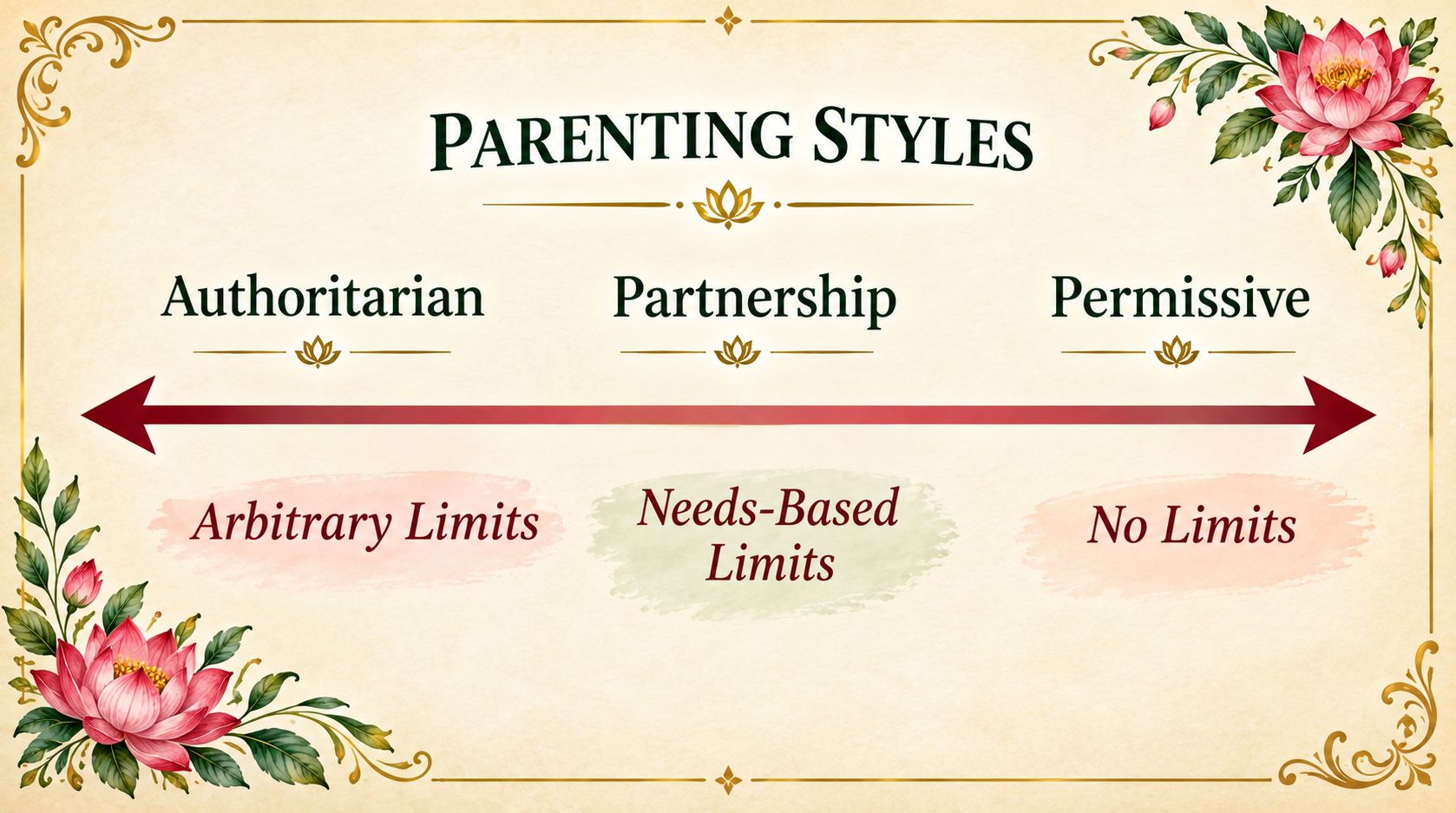
The key is to distinguish between needs and strategies. Our needs—for rest, safety, autonomy, connection, and consideration—are universal human needs. The strategies we use to meet them, however, can vary widely.
For example, a parent who needs rest might insist, “You must go to bed now because I said so.” A partnership approach begins with recognizing the needs underneath the struggle: perhaps the parent needs rest or connection with their partner at the end of the day. At the same time, the child longs for play, connection, choice, or autonomy. Can we find a way to honor both?
This doesn’t mean that children get whatever they want. Nor does it mean that parents abandon their own limits. Rather, we learn to express our needs honestly, listen to our children’s needs, convert the conflict into a dilemma, in which we invite their partnership to find solutions that take everyone into account.
External Rules or Needs-Based Limits?
When we rely on unilateral rules, shoulds, and musts, children may comply out of fear of punishment or in hope of a reward. This can breed resentment and leave them with little understanding of how their choices affect others.
Consider a child who doesn’t want to study. We might offer screen time as a reward for completing homework. While rewards can sometimes produce the desired behavior, they don’t necessarily help children develop an inner compass for making decisions.
What if, instead, we explored what matters to everyone involved? The child might need autonomy, rest, or recreation, while the parent needs reassurance about learning and responsibility. Together, we could explore a study routine that respects both sets of needs.
The difference is profound. Rather than simply enforcing a rule, we invite children into the process of understanding needs, considering others, and finding workable solutions.
NVC trainer Miki Kashtan highlights the value of limits that emerge from real-life circumstances and relationships. Working through these limits together helps children develop awareness of others’ needs, rather than simply learning to avoid punishment.
Of course, young children may not yet have the capacity to participate fully in these conversations. We initially do more of this work within ourselves, using our understanding of their needs to guide our decisions. As children mature, we can increasingly involve them in the process.
Sounds utopian?
Respecting Our Own Boundaries, Too
Partnership parenting begins with empathy—not only for our children but also for ourselves.
Our desire to be loving and compassionate does not erase our needs for rest, respect, safety, or autonomy. Respecting our own boundaries and caring for our children are not opposing goals.
When we understand our needs more deeply, we have greater freedom to respond with clarity rather than react from anger, resentment, or guilt. We can hold a firm limit while remaining open to dialogue and connection.
This is not always easy, especially when we are tired, overwhelmed, or under pressure (the typical life a parent in Kali yuga!). And we won’t get it right every time. But each struggle offers an opportunity to move away from control and toward mutual understanding.
A Resource for Parents
Think of a recent time when you enforced a rigid boundary with your child. What needs were you trying to meet? What might your child have been needing? Is there a way to approach that situation collaboratively while still honoring your own limits?
We don’t have to choose between being a loving parent and being a parent with boundaries. We can learn to do both.
If you’d like support exploring these challenges, we invite you to join our Parenting Support Group at The Atma Center, where we reflect together on what it means to parent with greater awareness, compassion, and connection in today’s fast-paced world.