Taking 100% Responsibility for Every Relationship
Ouch! That’s intimidating - 100% responsibility? Ain’t I one half of the relationship; shouldn’t I only be responsible for 50%, at best?
Eliminating the “should”, consider this an invitation for you to make choicefully…
Willingness & Capacity
Taking 100% responsibility means not stretching beyond my willingness or capacity, so that I don’t generate resentment in this relationship. When I blame the Temple Authorities for my burnout; when I complain that I am the only one who cleans up after the Sunday feast and no one in this congregation “gives a damn”; when I blame my mentor for having forced certain choices in my life; and when I blame my husband for the house load I carry to cook and clean–instead, let me turn inwards and seek the answer to the following question within the recesses of my heart–at what point did I allow myself to stretch beyond my willingness and capacity?
Resentment towards others is really resentment we harbor towards ourselves for not standing up for our needs. Instead, Brené Brown invites us to, "Choose discomfort over resentment"; practice the discomfort of vulnerability and clearly communicating and upholding our needs, rather than people-pleasing, and thus breeding long-term bitterness.
Anytime we stretch beyond our willingness and capacity, we make people pay for it - for instance through diminished goodwill or our passive aggressive behavior. Expand your capacity for voids instead–if there’s no one with willingness and capacity, mourn the unmet needs.
From Victim to Creator
Ever heard the cliché, “the nagging wife”? For too many of my married years, I would walk around sour-faced, complaining that my needs for connection, belonging, love, support…and the list went on and on… were not met by the man who I thought was the panacea for all the incompleteness within my heart. This flustered his need for autonomy, for all humans want choice in whether to meet other’s needs or not, making him less inclined to want to meet my needs. This served as confirmation to me that he didn’t care; we were caught in a vicious circle!
Instead, now, I believe in manifesting the need I want to see in the world! When I live into my vision or dream of our relationship, I have found that I create a magical and mystical energetic field around me that, in a very compelling manner, invites the other person to step into this vision of the relationship with me. From a victim of the other person’s hard-heartedness, stepping into my vision makes me a creator!
Stay in Your Lane
Taking 100% responsibility for every relationship also includes not expecting others to do their inner work. Unless there is a safety issue or abuse involved, within myself, I am committed to translating any blame, shame, or judgment that comes my way into an expression of unmet needs, instead of expecting the other person’s behavior or speech to change. I am committed to transforming my inner landscape, whether the person I’m in relationship with chooses to do their inner work or not. Because, as Mother Teresa put it, “You see, in the final analysis, it is between you and your God; It was never between you and them anyway.”
In my relationship with the Divine, I am responsible for the condition of my heart - the other person’s anartha nivritti is not my project. Whether they settle their accounts with God is not my area of responsibility. Let me focus on settling my own accounts. This role modeling is my most effective means of supporting them in their own meandering journey.
Taking Initiative to do the Repair Work
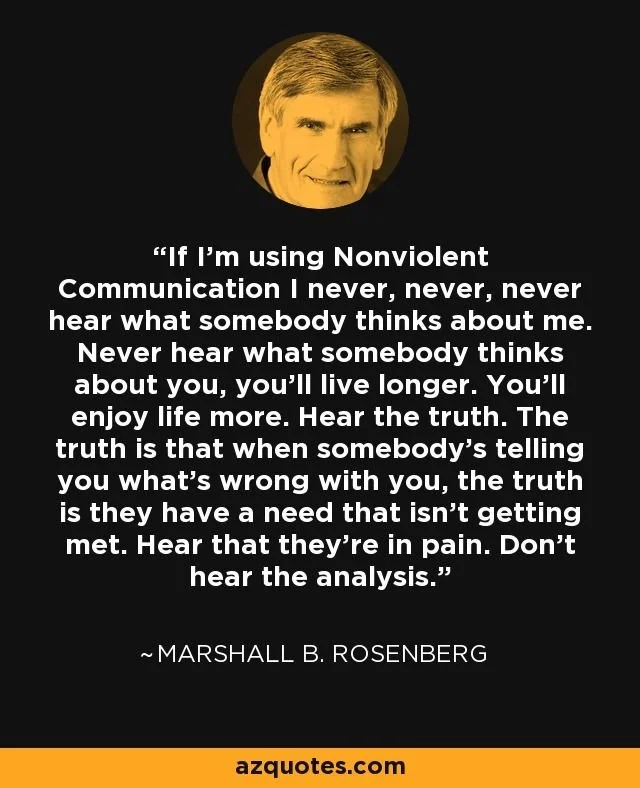
Taking 100% responsibility for the relationship means that when I realize that I have acted out of alignment with my values in the relationship, I take the initiative to rebuild trust and repair the relationship, without any expectation of the other person that they acknowledge their share of “the harm they’ve caused.” Oh how many times have I assumed that I was ready to take ownership of my part and had no expectation of a “sorry” from the other person, taken initiative to engage in repair dialogue, and as soon as they started inventoring the "wrongdoings" on my part, I got defensive. My mind screams, “At least I am owning my part of the issue. You are not even apologizing. You know it takes two to tango!”
The ability to separate out our beautiful, universal human needs from the strategies we use that might be harmful is key to grounding in our innocence during such conversations. If we carry innocence fragility, then we buy into the other’s image of our wrongness, and this impels us to defend ourselves.
Instead, if we are convinced that another person’s criticism of me defines their thinking, not my being, I relinquish my self-appointed charge of being the deputy of justice and fairness. I can remain tender, better able to cull the useful aspects of their feedback. I am tired of being stuck in this samsara of “being right”; in this life, I choose to grow. With this orientation of heart, I am finding that I am having far-reaching impacts on the world.
This is deeply spiritual work. If we are firmly secure in our relationship with the Divine, we can rest our weary hearts from the tendency to defend ourselves. The resulting open-heartedness gives us the freedom to take in how we have impacted others as information, rather than confirmation of ‘our badness’. Our brokenness which impacts others, then, is tragic, not wrong or immoral. And for our brokenness, we can step up to take 100% responsibility.
The Difference between Care and Care-Taking
Taking 100% responsibility for the relationship does not equal enmeshment, where we become rescuers, carrying the emotions of others. We understand that all emotions stem from an internal assessment of whether needs are met or unmet. And yet, we care deeply about others meeting their needs, supporting them by using strategies that care for the whole.
My “God” Project
We all have a tendency to try to be isvara. Rather than cajoling, demanding, and shaming others to transform, I have chosen my own purification as my “God” project. May I Rest in Peace!